Seed Bead Sizes and Finishes Explained: From 15/0 to 6/0
Seed beads might look like tiny specks in a jar, but their size and surface treatment dramatically change what you can make with them. The aught system feels backward at first: a 15/0 bead is much smaller than a 6/0. The number before the slash tells you how many beads roughly fit into one inch when lined up side by side. So 15/0 means about fifteen beads per inch, while 6/0 gives you only six. That inverse logic trips up every beginner until the ruler becomes your friend.
Thinking in beads-per-inch helps you picture scale instantly. A 15/0 is whisper-thin, perfect for delicate lacework. Jump to 11/0 and you’re in the sweet spot most stitchers live in. Larger 8/0 and 6/0 beads feel almost chunky, great for statement pieces or when you want the bead itself to be part of the texture.
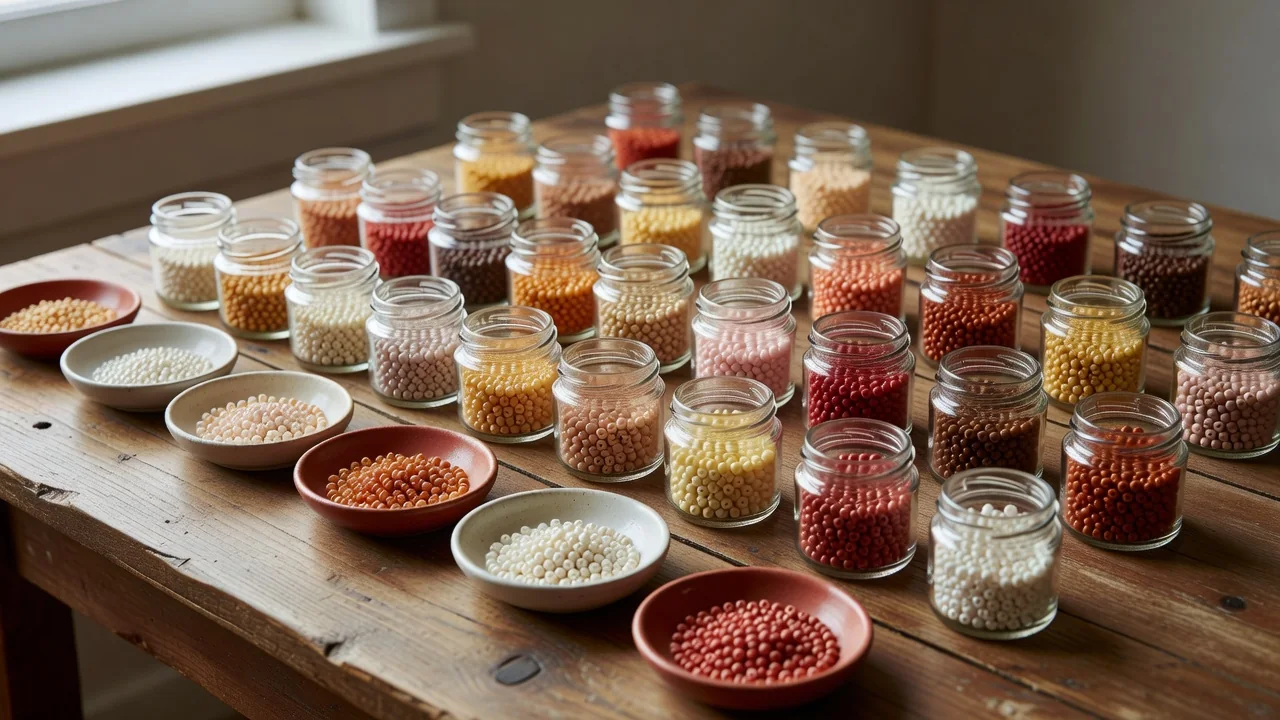
Round versus Cylinder: Why Shape Matters
Round seed beads have that classic donut shape with slight variations in size. Cylinder beads, often called Delicas or Treasures, are precision-cut tubes with straight sides and very consistent diameters. The uniformity of cylinders makes peyote stitch sit flat and even, and it turns loom weaving into buttery-smooth rows where every bead snaps into place. Rounds are more forgiving for freeform work or pieces where you want a bit of organic movement.
Finish choices affect both look and longevity. Opaque beads block light completely and stay vibrant. Transparent beads let color shine through, especially when layered over different thread colors. Matte finishes give a soft, chalky glow that feels modern. Metallic and galvanized coatings add shine but can rub off with years of skin oils and abrasion. Silver-lined beads have a reflective core that makes colors pop yet the lining can eventually darken. Aurora-borealis or AB coatings create an iridescent rainbow effect; the thin film sometimes wears at high-friction spots like bracelet edges or ring shanks.
Buying Smart: Hanks, Tubes, and Grams
Most suppliers sell seed beads by the hank (a bundle of 12-20 temporary strands), by the tube (a small plastic vial with a set weight), or by the gram. Hanks are traditional for larger sizes and work well when you need consistent color across many strands. Tubes are convenient for smaller projects and let you see the exact color before committing. Buying by gram is the most accurate way to compare value across sizes because weight accounts for the different hole sizes and wall thicknesses.
Choose your size based on the technique rather than grabbing whatever is prettiest in the store. A 15/0 will disappear in a chunky necklace but will make exquisite fine fringe. An 8/0 can form the backbone of a bold woven cuff yet feel too heavy for tiny earrings.
| Size | Beads per Inch (approx.) | Best Uses |
|---|---|---|
| 15/0 | 15–17 | intricate weaving, tiny fringe, micro embellishment |
| 11/0 | 11–13 | peyote stitch, loom work, standard stringing, most beadweaving |
| 8/0 | 7–9 | statement bracelets, larger loom patterns, light fringe |
| 6/0 | 5–7 | bold necklaces, chunky earrings, decorative accents |
Keep a small ruler or caliper near your bead tray. After measuring a few strands you’ll start to feel the differences without counting. The real joy comes when you match the right size and finish to the project you’re dreaming up. A matte 11/0 cylinder in peyote creates crisp geometric lines that a round opaque bead could never match, while a galvanized 6/0 adds just the right metallic wink to a simple strung bracelet. Understanding these basics removes the guesswork and lets your creativity take the lead.
- Always test new finishes against skin and clothing before investing in large quantities.
- Store galvanized and metallic beads away from moisture to slow wear.
- Buy a few extra grams of cylinder beads; their uniformity means you’ll use them faster than you expect.
Once the sizes and finishes click, seed beads stop being mysterious specks and become reliable design partners. Your next piece will sit better, wear longer, and look exactly like you imagined it.