How to Organize a Growing Bead Stash Without Losing Your Mind
Every beader knows the moment: your collection has quietly doubled, and suddenly every surface is covered in half-used tubes and mystery mixes. By 2026 many of us are managing thousands of beads, and the difference between creative flow and total chaos often comes down to a few smart systems rather than endless new containers.
The secret is building a storage plan that matches how you actually work. Sort first by broad type—seed beads, shaped beads, gemstones, findings—then by size within each category, and finally by color family. This logic lets you grab a single drawer or binder and see every 11/0 option in one place instead of hunting across the room. Once sorted, label every container with both size and finish (“8/0 matte metallic,” “6 mm rainbow luster”) so the information remains useful even after the original packaging disappears.
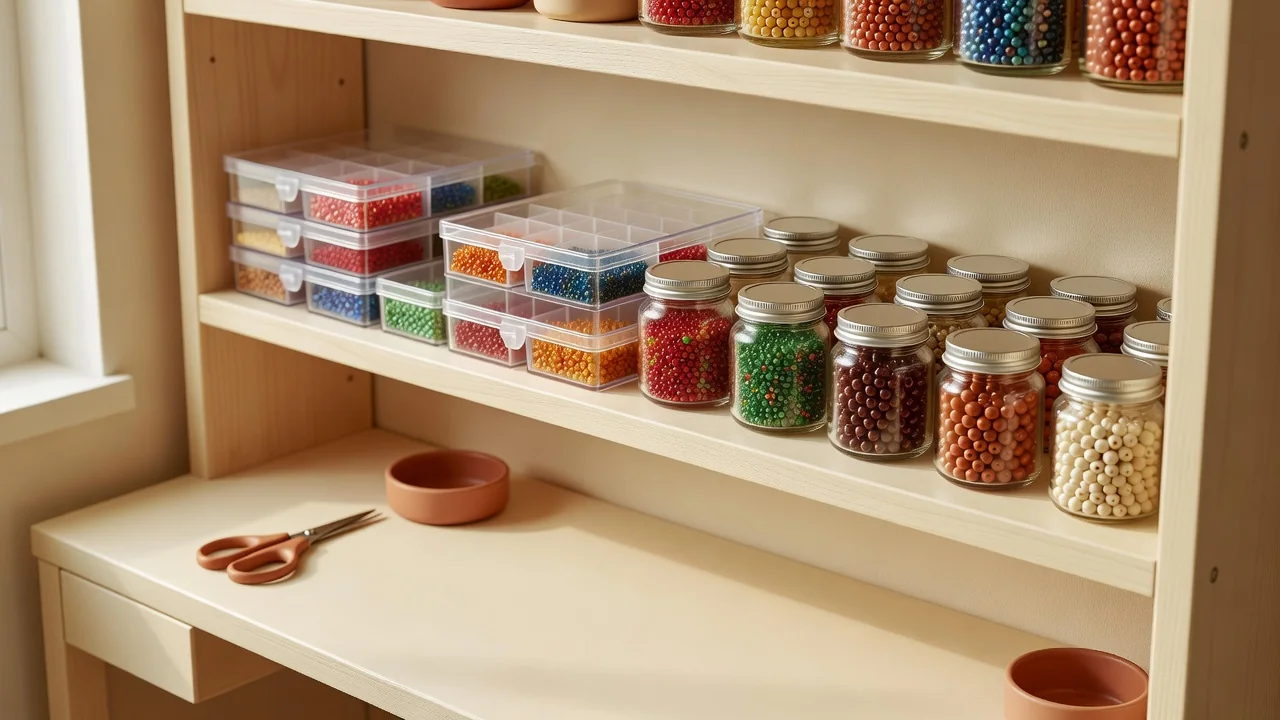
Choosing Storage Formats
Different formats solve different problems. Flip-top compartment boxes offer quick access and let you see many colors at once, but small compartments fill fast and lids can pop open if overpacked. Screw-top stackable jars keep larger quantities tidy and stack vertically, yet they hide contents until you open them. Small zip bags inside three-ring binders work beautifully for seed beads; the bags stay flat, you can write directly on them, and the binder lives on a shelf. Shallow drawer cabinets give the best visibility for medium beads and findings, though they take up more horizontal space.
| Format | Capacity | Visibility | Cost Level |
|---|---|---|---|
| Flip-top compartment boxes | Low to medium (typical 10–30 compartments) | High when open | Medium |
| Screw-top stackable jars | Medium to high (50–200 ml each) | Low until opened | Low to medium |
| Zip bags in binders | Low per bag, high overall | Medium (can fan pages) | Low |
| Drawer cabinets | Medium per drawer (illustrative 20–60 items) | Very high | Medium to high |
Inventory and Protection Habits
Keeping a simple inventory prevents overbuying and helps with project planning. A small notebook or spreadsheet listing approximate quantities (“Seed beads, size 11/0, silver: ~4500”) updated once or twice a year is enough. For metal findings, add silica packets inside their containers and store them away from bathrooms or kitchens where humidity spikes. Many makers also keep a separate “work-in-progress” box or tray so half-finished pieces don’t get mixed back into the main stash, which is the fastest route to frustration.
Creating a Sustainable System
Start small: tackle one bead type per weekend. Empty everything onto a clean table, sort into piles, then transfer into your chosen containers. Once the main categories are organized, the system tends to maintain itself because putting things away becomes intuitive. Leave a little empty space in each container—about 20 percent—so future purchases have room without forcing a complete reshuffle. Over time you will develop favorites among the formats; many experienced beaders end up using a hybrid approach, with drawers for gemstones, binders for delicas, and jars for larger Czech glass.
The goal is never perfection. It is simply reducing the mental load so that when inspiration strikes you can reach for exactly the right bead instead of spending twenty minutes digging through chaos. A well-organized stash turns a growing collection from a burden into a genuine creative asset.
- Sort by type, then size, then color for fastest retrieval
- Label every container with size and finish details
- Maintain a basic quantity inventory for project planning
- Use silica packets with metal findings to fight humidity
- Keep active projects in a clearly separate tray or box