The science of bead materials: why some glass beads fade, crack or yellow with time
You string a bracelet with vivid turquoise beads in June. By the following spring, the turquoise has gone from Caribbean blue to a washed-out grey-green, and the silver-lined accents that caught the light so beautifully now look like dull tin foil. The beads did not break. They did not get wet. They simply sat in a jewelry box and aged — visibly, irreversibly, and for reasons that most beaders never learn. The degradation of glass beads is not a mystery or a manufacturing defect in most cases. It is chemistry, and it is predictable. Understanding why certain beads deteriorate — and how to identify them before you buy — can save a maker from the heartbreak of watching a carefully designed piece lose its beauty while sitting quietly in a drawer.
What glass actually is, and why that matters
Glass is not a solid in the traditional sense. It is an amorphous material — a supercooled liquid in which the molecules are locked in a disordered state rather than arranged in a crystalline lattice. This structure gives glass its transparency and its ability to be molded when heated, but it also makes it vulnerable to specific types of deterioration that crystalline materials like quartz or sapphire resist naturally.
The primary ingredient in most decorative glass is silica (silicon dioxide), which melts at around 1700°C. Because that temperature is impractical for most bead manufacturing, fluxes are added to lower the melting point. Soda ash (sodium carbonate) brings it down to roughly 800°C, and lime (calcium oxide) is added to stabilize the mixture and prevent the glass from dissolving in water. This soda-lime-silica formulation accounts for the vast majority of beads produced worldwide — from Czech pressed glass to Chinese bulk seed beads — and its exact composition determines how the bead will behave over decades.
Borosilicate glass, which adds boron oxide to the mix, has a lower coefficient of thermal expansion and greater chemical resistance. It is used for some higher-end artisan beads but is less common in mass-produced bead production due to its higher cost and more demanding manufacturing requirements. Lead crystal, which replaces some of the calcium with lead oxide, has a higher refractive index and exceptional brilliance, but the lead content introduces its own long-term stability issues.
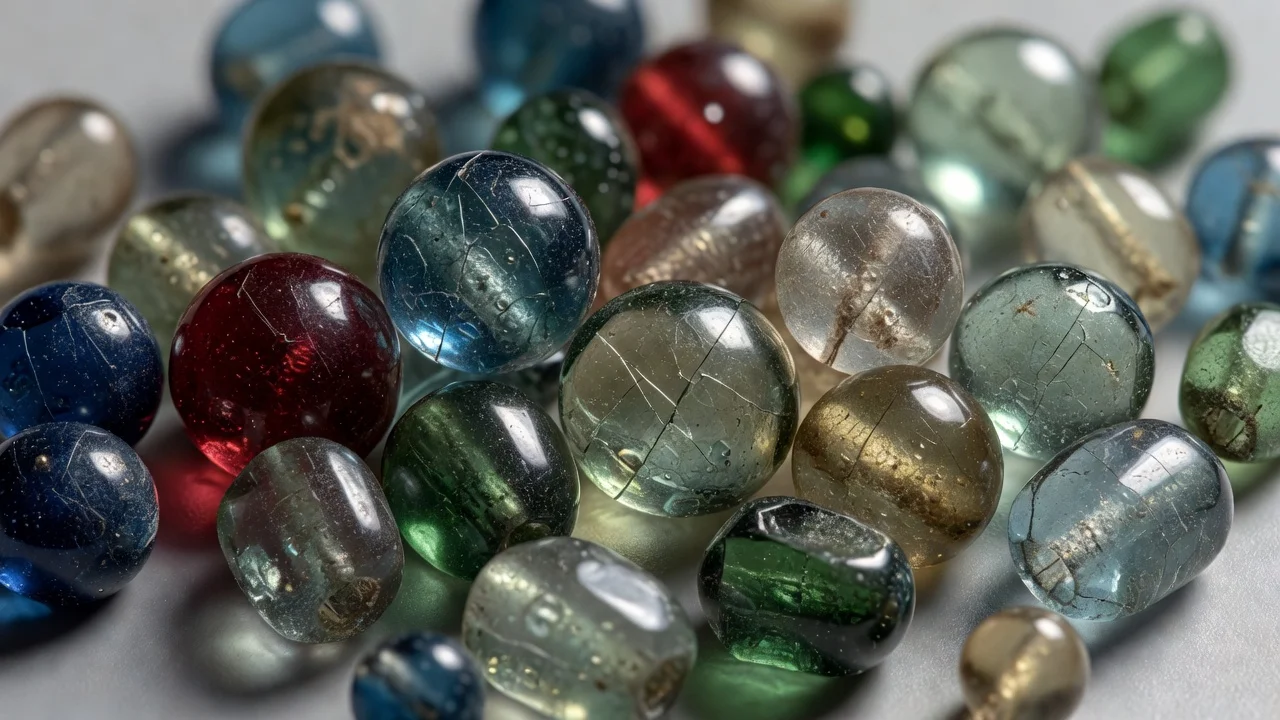
Why some glass beads fade
Color fading in glass beads is rarely the glass itself breaking down — glass is chemically stable for centuries under normal conditions. What fades is the coloring agent, and the type of colorant used determines whether a bead will hold its hue for a season or a century.
Color in glass comes from one of three sources: metal oxides dissolved in the glass matrix, metallic salts applied as a surface coating, or organic dyes impregnated into the surface or a lining inside the bead hole. Each of these has a dramatically different permanence profile.
Metal oxide colors — cobalt for blue, chromium for green, manganese for purple, iron for brown — are locked into the glass structure at the molecular level. They cannot fade because they are part of the glass itself. A cobalt-blue bead made in 1850 is the same shade of blue today. These are called "body-color" or "through-color" beads, and they are the most permanent form of colored glass.
Surface coatings are the most common cause of fading. Many beads achieve their color through a thin metallic or chemical film applied to the exterior of a clear or lightly tinted glass bead. These coatings include iris and aurora borealis finishes (metallic salts bonded to the surface), galvanized finishes (zinc or other metals vapor-deposited onto the glass), and luster coatings (metal oxides applied as a surface wash). UV light breaks down the metallic bonds in these coatings over time, causing the color to thin, shift, or disappear entirely. Heat and skin oils accelerate the process. A galvanized silver bead can lose its finish in months of regular wear, while an iris coating in a protected display may last years before showing deterioration.
Dye is the least permanent colorant of all. Some beads — particularly certain seed beads, bone beads, and wooden beads — are colored by soaking them in dye solutions that penetrate the surface layer. UV light, water, and friction all remove dye rapidly. A dyed bead can fade in a single summer of sun exposure, and no amount of care will prevent it — the degradation is inherent to the colorant.
Why glass beads crack
Cracking is a structural failure that occurs when internal stress exceeds the tensile strength of the glass. Glass is strong in compression but weak in tension, which means it resists squeezing but breaks easily when pulled. Several mechanisms can introduce tensile stress into a bead, and they fall into two categories: thermal stress and mechanical stress.
Thermal stress is caused by uneven heating or cooling during manufacturing or use. When glass is heated, it expands. When it cools, it contracts. If different parts of the bead cool at different rates, the contraction is uneven, and internal stress builds up. If that stress exceeds the glass's tolerance, the bead cracks — sometimes immediately, sometimes months or years later when a minor temperature change provides the final push. This is the root cause of most spontaneous cracking in beads that appear to break for no reason.
The coefficient of thermal expansion (COE) is the measure of how much a glass expands and contracts per degree of temperature change. Different glass formulations have different COEs, and when beads of different COEs are fused together — as in some lampwork or composite beads — the mismatch creates permanent internal stress. A bead with a COE of 104 (typical Italian soft glass) fused to a bead with a COE of 33 (borosilicate) will develop stress at the interface that can cause cracking even without any external force.
The manufacturing process that prevents this is called annealing — holding the glass at a specific temperature just below its softening point, then cooling it slowly and evenly to allow the internal stresses to relax. Properly annealed beads are stable and can last indefinitely. Improperly or non-annealed beads carry internal stress from the moment they are made and are prone to cracking throughout their lifetime.
The following comparison shows how different glass bead types perform across the key degradation factors, giving a practical reference for makers who want to predict how their materials will behave over time.
| Bead type | Color permanence | Crack resistance | Yellowing risk | UV sensitivity | Typical lifespan (visible degradation) |
|---|---|---|---|---|---|
| Soda-lime through-color (e.g. cobalt, ruby) | Excellent — color is molecular | Good if annealed | Very low | Very low | 100+ years |
| Soda-lime coated (iris, AB, galvanized) | Poor to moderate — coating degrades | Good if annealed | Low (coating fades before glass yellows) | High — UV breaks coating bonds | 1–5 years (coating wear) |
| Seed beads, dyed | Very poor — dye is surface-level | Moderate — thin walls crack under stress | Low | Very high — dye photodegrades | Months to 2 years |
| Lead crystal | Good — metal oxide colors | Moderate — lead makes glass softer | Moderate — lead oxide can darken | Low | 20–50 years before yellowing |
| Borosilicate | Good if through-color | Excellent — low COE, highly annealed | Very low | Very low | 100+ years |
| Lampwork (artisan, properly annealed) | Depends on colorant used | Excellent | Low | Depends on colorant | 50+ years |
| Lampwork (mass, poorly annealed) | Depends on colorant used | Poor — internal stress | Low | Depends on colorant | Prone to sudden cracking at any time |
The clear pattern in this comparison is that the colorant type and the annealing quality matter more than the glass formulation itself. A well-annealed soda-lime bead with through-color will outlast a poorly annealed borosilicate bead with a surface coating. The price of the bead is not a reliable indicator of its longevity — some inexpensive Czech through-color beads will last longer than premium coated crystal beads that cost ten times as much.

Why glass beads yellow
Yellowing is a distinct phenomenon from fading. It is not the loss of color but the development of a yellow-brown discoloration in glass that was originally clear or white. This is the slowest form of glass degradation and the least understood by most beaders.
The most common cause of yellowing in older glass is UV-induced oxidation of metal ions within the glass matrix. Manganese, which was historically used as a decolorizer to counteract the natural green tint of iron-contaminated silica, turns yellow-brown when exposed to UV light over long periods. This is why antique clear glass often has a pale amber tint — the manganese has oxidized. Modern glass uses different decolorizers (selenium or cerium) that are more UV-stable, but older beads and some inexpensive modern beads still contain manganese.
Lead crystal beads can develop a yellow tone as the lead oxide interacts with sulfur compounds in the air, forming lead sulfide. This process is extremely slow — it takes decades — but it is the reason that old chandelier crystals and vintage lead-glass beads sometimes appear yellowed. The process is irreversible, though the yellowing can be slowed by storing beads away from sulfur sources (which include certain types of rubber, wool felt, and air pollution).
A third cause of yellowing is the degradation of organic additives in certain composite or specialty glass products. Some beads marketed as "glass" actually contain resin or polymer components — either as a bonding agent in composite beads or as a surface layer on coated beads. These organic components yellow through the same photo-oxidation process that affects plastics and varnishes, and they do so much faster than true glass yellows.
The coefficient of thermal expansion in practice
The COE is not just a theoretical number — it has direct practical consequences for beaders who work with mixed materials. When a maker combines beads of different glass types in a single piece, temperature changes cause each bead to expand and contract at a different rate. The friction between beads of different COEs during temperature fluctuations introduces stress at the contact points, which over years can cause chipping, micro-cracking, and eventual failure.
This is particularly relevant for jewelry that is worn against the skin, where temperature shifts between body heat and ambient room temperature occur daily. A necklace combining soda-lime pressed beads (COE ~96) with borosilicate accent beads (COE ~33) will experience differential expansion with every wear. The effect is subtle and takes years to manifest, but it is a real degradation pathway that purists and conservators take seriously.
For most practical beading purposes, mixing different glass types within a single piece is perfectly acceptable — the stresses involved are small and the glass is thick enough to tolerate them. The real danger comes when beads are fused or soldered together, or when they are used in applications involving significant temperature changes, such as kiln-fired bead embroidery or jewelry that will be left in a hot car.
Identifying at-risk beads before you buy
Preventing degradation starts at the point of purchase. Knowing how to identify through-color beads versus coated beads, well-annealed beads versus poorly annealed ones, and stable glass versus composite or resin-containing products is the most practical skill a beader can develop.
Several visual and tactile tests can help identify bead quality without specialized equipment:
- The light test — hold the bead up to a bright light. Through-color beads show uniform color throughout the glass, including inside the drill hole. Coated beads show clear or differently colored glass inside the hole, with color only on the surface. This is the single most reliable test for color permanence.
- The scratch test — gently scratch an inconspicuous area with a steel needle. Through-color glass will not lose color because the color extends through the material. Coated beads will show a scratch mark where the coating is removed, revealing the underlying glass.
- The temperature test — for lampwork beads, warm the bead slightly with body heat and then touch it to a cool surface. A properly annealed bead will tolerate the temperature change without issue. A poorly annealed bead may produce a faint click or ping sound as micro-fractures propagate — though this test is destructive and should only be used on sacrificial samples.
- The weight test — lead crystal beads are noticeably heavier than soda-lime beads of the same size. If a "crystal" bead feels light, it may be glass with a lead-content coating rather than true lead crystal, which means it will not yellow but its coating may degrade.
- The acetone test — for beads suspected of being dyed rather than through-colored, dip a cotton swab in acetone (nail polish remover) and rub an inconspicuous area. Dye will transfer to the swab; through-color glass will not. This test is destructive to the bead's finish, so use it on a spare.
These tests are not necessary for every bead in every project, but they are invaluable when a maker is evaluating a new supplier or deciding whether to invest in a bulk purchase of an unfamiliar bead type. A single afternoon of testing can prevent years of disappointment.
Environmental factors that accelerate degradation
Even the most stable glass beads will degrade faster in certain environments. UV light is the most powerful accelerator of coating and dye degradation. A coated bead that lasts five years in a jewelry box may lose its finish in a single summer of daily wear in direct sunlight. Temperature cycling — moving between a heated house and a cold car, or between body heat and cool water — accelerates stress cracking in poorly annealed beads. Humidity affects some coatings and dyes, particularly metallic finishes that can oxidize in moist conditions.
The environmental factors that most commonly damage beaded jewelry, and how to mitigate them, include:
- UV exposure — direct sunlight through windows contains enough UV to degrade coatings and dyes over weeks. Store pieces away from windowsill light, and avoid wearing coated beads during prolonged outdoor sun exposure. Display cases should use UV-filtering glass if pieces are shown long-term.
- Temperature cycling — rapid changes between hot and cold stress the glass and can trigger cracking in poorly annealed beads. Avoid leaving jewelry in cars, near radiators, or in bathrooms where shower steam creates rapid temperature swings.
- Skin chemistry — acidic skin pH, perspiration, and skin care products all interact with bead surfaces. Galvanized coatings are particularly vulnerable to acidic skin, and some people can wear through a galvanized finish in weeks. Silver-lined beads also tarnish rapidly against acidic skin. Test-wearing a piece for a few days can reveal whether skin chemistry is compatible with the bead type.
- Chemical exposure — perfumes, lotions, sunscreens, and household cleaners all contain compounds that can degrade coatings, dyes, and even some glass surfaces. Apply cosmetics before putting on jewelry, and remove jewelry before cleaning or swimming.
- Storage conditions — beads stored in direct contact with each other can abrade coatings through friction. Acidic storage materials — certain woods, some plastics, and sulfur-containing fabrics like wool felt — can accelerate lead crystal yellowing. The best storage is individual soft cloth pouches or acid-free tissue paper in a temperature-stable environment.
- Friction during wear — beads that rub against each other on a strand wear their surfaces over time. Knotted strands, where each bead is separated by a knot, reduce friction significantly and extend the life of coated finishes.
Mitigating these factors does not require hermetic sealing or museum-grade conservation. It requires awareness — knowing which beads are vulnerable, which environments accelerate their vulnerability, and making storage and wearing choices that minimize exposure. A coated bead stored in a cloth pouch and worn occasionally will outlast the same bead worn daily and left on a sunny dresser.
Choosing beads that will not disappoint
The most practical advice for beaders who want their work to last is also the simplest: choose through-color beads from reputable manufacturers whenever possible. Czech pressed glass through-color beads are among the most affordable and most permanent options available. Japanese seed beads — particularly Miyuki and Toho — offer through-color lines alongside their coated options, and the through-color versions cost only slightly more. For premium work, borosilicate lampwork beads from established artisans who document their annealing process offer the highest structural reliability.
Coated beads are not inherently bad — they offer colors and effects that through-color glass cannot achieve, and their beauty is real even if it is temporary. The key is using them with full awareness of their lifespan, in pieces that are meant to be enjoyed for a season rather than a generation, and pricing and marketing them accordingly. A bracelet made with galvanized beads should not be sold as an heirloom any more than a cotton dress should be sold as a winter coat. Honesty about materials — to yourself and to your customers — is the foundation of work that lasts because it was designed to last, and because the expectations of the person wearing it match the reality of what it is made from.